

No data? Proceed undaunted
Although lacking data can make investigating governmental irregularities difficult, it’s not insurmountable. There’s always a way to find information, especially if you think outside the box.

Welcome back to Don’t Forget My Voice, a newsletter to help you navigate journalism’s chaotic and toxic maze. I’m Mc Nelly Torres, a longtime investigative journalist, editor, trainer and mentor.

Sometime in 2013 I began looking into violent crimes committed against people using automated teller machines.
I was the associate director and co-founder of Florida Center for Investigative Reporting, a bilingual digital investigative nonprofit organization launched in 2010. A source contacted me to share his frustrations with the Florida Legislature’s lack of action about this issue affecting Floridians every other week.
As I began my research, I found that my source was right. Although ATMs offer access to bank accounts around the clock, they can also be magnets for violent crime. Media reports had documented this problem, showing that people using ATMs have been shot, beaten, raped and killed as their money was taken away.
But my story revealed that this problem was largely underreported because nobody tracks these crimes — not the FBI, not the police, not the banking system.
I knew that anecdotal evidence gives news stories their human element, and that part I had; people were willing to talk. But I needed data, too, to quantify and illustrate the problem’s seriousness.
I’ve always been attracted to complex stories other reporters ignore because it requires analytical skills, time and effort. I initially used Lexis/Nexis and Google to research media coverage and assess the problem’s scope. My first searches yielded dozens of incidents reported statewide not just in Florida, but across the nation.
These early numbers showed me I had a story worth pursuing. I knew I needed to collect and build my own data, too. So, I started filing records requests in numerous law enforcement agencies in Broward and Miami-Dade counties to obtain emergency or service calls coming from banks with automated teller machines. The data led me to request written police reports, where I found good narratives and examples of people victimized by violent crime at ATMs.
I also interviewed victims’ attorneys, and crime and security experts to strengthen the reporting.
My initial analysis showed that banks with the highest number of reported crimes, including fraud, theft, burglary and bank robbery, were likelier to have armed robberies that were “sometimes violent” at their ATMs. After I accumulated all this reporting, I partnered with WTVJ’s Willard Shepard to prepare a report.
Collaborations are a great way to share resources and skills and widen the audience for our investigations. The Florida Center for Investigative Reporting was a fairly new organization in the state; having our stories on television, local newspapers and radio gave us welcome exposure.
As Shepard, a longtime investigative reporter and attorney in South Florida, began his own reporting, he brought in a lighting security expert to inspect and document ATMs at night. We had discovered that banks in Florida had to meet some requirements by law.
Adequate lighting during dark hours in parking, access areas and around ATMs.
Reflective mirrors to allow customer a rear view while using the machine.
Any landscape, vegetation or other physical obstructions in the area shouldn’t exceed 3 feet high and the area must be well lit for any open and operating ATM.
Shepard and I wanted to find out whether banks were meeting these requirements.
Although the Florida Office of Financial Regulation oversees the state’s financial institutions, inspecting banks and enforcing these minimum ATM safety requirements, it was hard to know whether it had been enforcing these regulations.
A financial regulation officer spokesperson told us the state agency had 118 full-time inspectors assigned to visit all state banks every 18 months. Yet, we found that no citations or penalties have been issued to any of the 250 Florida state banks from 2009-13. Our investigation found that banks frequently failed to adhere to safety regulations, leaving consumers vulnerable to violent ATM crimes such as robberies and carjackings.
Although Florida law mandates proper lighting and surveillance, our reporting showed enforcement is lax, and banks weren’t tracking ATM violence incidents. It was also difficult to gauge whether most banks were meeting at least minimum standards because inspections were, and are, confidential.
The banking lobby tries to keep litigation cases confidential, our investigation found.
Chris E. McGoey, a Los Angeles-based security consultant and private investigator told me then that banks don’t want the public to know which ATMs are in dangerous locations.
“Why is this ATM open at night if all these crimes have occurred?” McGoey said. “You know that someone is going to die eventually, and if the public knew that a robbery would be more likely to occur at that location at night, would they go?”
ATM violence survivors and their attorneys described to us clear violations of state law: ATMs with missing or damaged mirrors; ATMs with shrubbery; and ATMs with poor lighting in parking lots.
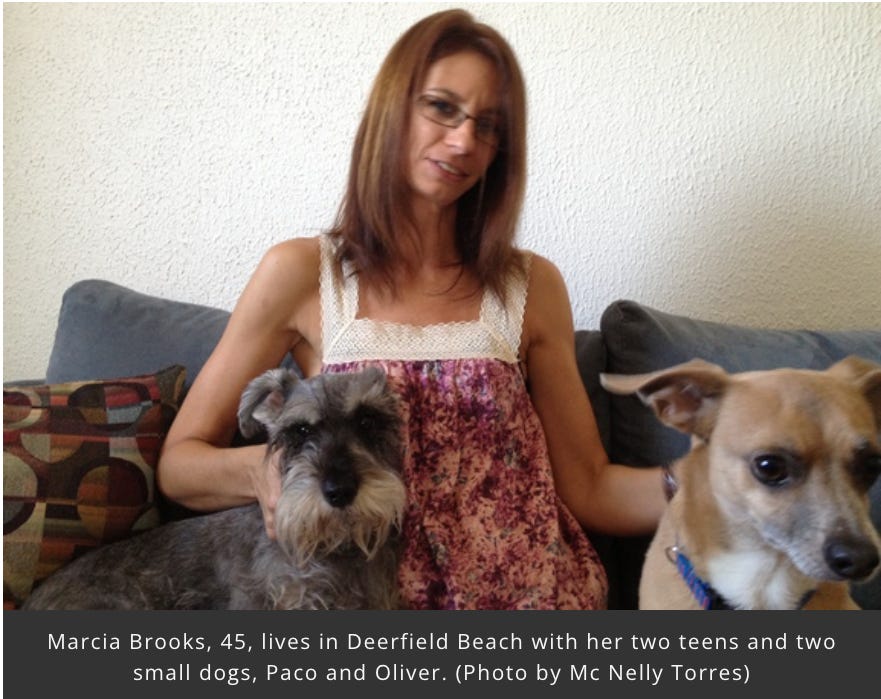
This is exactly what Marcia Brooks encountered July 29, 2012, when she stopped at her neighborhood bank in Pompano Beach. She was making a deposit at the ATM before heading to her Walgreens job.
At 10 p.m., Brooks parked her Ford Focus on the curb about 10 feet away from the Wells Fargo ATM.
She had completed her transaction when a red Chevrolet rushed toward her, stopped abruptly and blocked her car. A man wearing a stocking to conceal his face jumped from the passenger’s seat, pointed a handgun at her face and demanded money.
Brooks froze.
“I knew there was no place for me to go,” Brooks told me. “It was terrifying.”
The robber pressed the gun against Brooks’ neck and ordered her to withdraw cash. She complied, withdrawing the money she had deposited minutes before, I wrote then.
Brooks, then 45, prayed for someone to rescue her even though she knew it was unlikely — the building’s back blocked the view from busy Federal Highway, making it difficult for anyone to see the robbery in progress.
The gun wielder took the money and left Brooks unharmed and standing in front of the ATM. Her car was not taken and police never found the two men who robbed her.
I interviewed Brooks, a single mother of two teens, in her home. She sat on her gray couch with her two small dogs, Paco and Oliver, and told me she was angry to have been victimized, but grateful to be alive.
“They could have shot me or raped me.”
Brooks didn’t know that this specific Wells Fargo branch had had numerous incidents in recent years, including larceny, fraud and bank robberies in 2008, 2010 and 2012.
Powerful banking lobby
The Florida banking lobby, which had contributed at least $9 million to state legislators when I was reporting on this, opposes stronger safety measures. It tried to shift the responsibility to individual consumers, our investigation found.
As victims of ATMs crimes hold banks accountable in civil court each year, banks’ settled cases to avoid trials, keeping information confidential and away from public disclosure.
Jason Turchin, a Weston-based attorney who represents ATM crime victims in Florida, Washington and New York, told me he sometimes agrees to settle cases because his clients want closure after enduring the trauma of a violent crime.
“Unfortunately, the only way banks take responsibility is by writing a check,” Turchin told me as he shared that he had settled a case early that year (2013) for a woman who was sexually assaulted at an ATM in Tampa.
Joseph Gleason, a Lakeland attorney, had a simple question: Why could he go online and search for sex offenders in any neighborhood in Florida but couldn’t find dangerous ATMs?
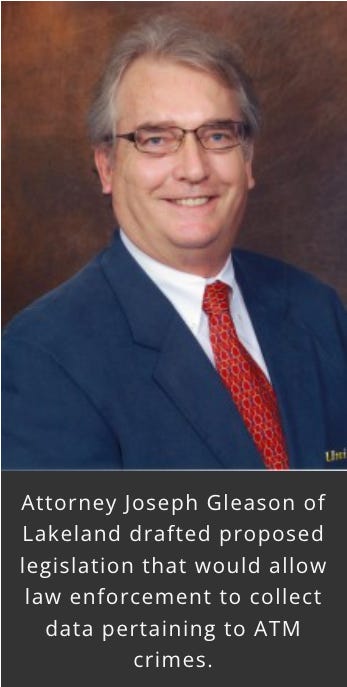
Gleason had seen the headlines after ATM users were robbed at gunpoint, assaulted, sometimes killed. In 2012, he began the arduous task of contacting law enforcement agencies in all counties in the state solely to file open records requests for crimes related to ATMs.
Gleason discovered that ATM-related crimes are not documented like other crimes, such as burglaries, homicides or assault.
Every year, the Federal Bureau of Investigation publishes the Uniform Crime Report, which has become the official measurement of crime in the U.S. But even as it documents murder, manslaughter, forcible rape, burglary, aggravated assault, larceny, arson and motor vehicle theft, the report has no category for ATM-related crimes, I wrote then.
“I never thought it would be this difficult,” Gleason told me. “I thought this would be a piece of information that law enforcement would want to have.”
When the Federal Trade Commission tried to study this issue, a mandate of the Credit Card Accountability Responsibility and Disclosure Act of 2009 (CARD), the agency couldn’t collect data pertaining to ATM crimes.
Despite the dearth of data, Rob T. Guerette, then an assistant professor in the School of Criminal Justice at Florida International University in Miami who has studied this issue, said anecdotal evidence suggests that there’s a growing ATM crime problem.
“Nobody is taking the leadership to systematically record the ATM phenomenon,” Guerette told me. “Until we do that, we can’t launch any meaningful initiative to try and reduce it.”
Florida’s Gleason tried proposing legislation to address this problem, and approached several state legislators. But he found no takers in 2013.
Alex Sanchez, the Florida Bankers Association’s then president, told me financial institutions took safety seriously.
“Our job is to provide a safe and good experience for our customers,” Sanchez told me.
But John E. Leighton, an attorney based in Miami and the author of “Litigating Premises Security Cases,” disagreed.
“They say consumers should know it is dangerous,” Leighton said. “But when a consumer goes to an ATM and they see light and mirrors, they think it must be OK because the bank is providing that convenience.
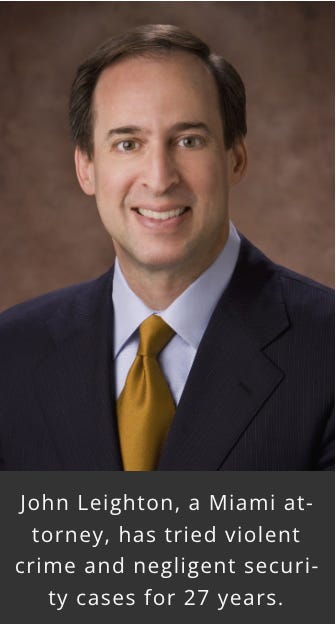
Leighton represented the family of Alfred L. Gordon Sr., an Orlando police officer who was off duty when he was shot and killed during a robbery at a 2007 ATM. Leighton told me this ATM had poor lighting, mirrors were missing and it was in a high-crime area.
The Gordons filed a wrongful death lawsuit against the two men convicted for Gordon’s murder, Bank of America and the shopping center that housed the bank.
The bank and the shopping center settled out of court for an undisclosed amount. A jury awarded the family $24.5 million that targeted any future earnings his killers might collect.
“Florida regulations have no teeth,” Leighton said then “and the only way to seek justice for victims is through the civil court system.”
Finding a way
Experienced investigative journalists are willing to think outside the box and experiment with new tools. Since this story, I’ve worked on projects using tools like surveys to collect data needed to dig deep into an issue. And, in this story, I brought in a partner from a different platform to share resources and help investigate.
Shepard and his producer visited a few ATM locations at night with a lighting safety expert and found poor lighting, and broken mirrors, corroborating stories ATM crime victims had shared with us and with the police.
The story was published Nov. 30, 2013, with a headline: “Banks fail to protect consumers from ATM crime.”
Yes, the investigation was long. And yes, banks’ efforts to keep data confidential made our work harder. But every instant and headache paid off; we knew this the moment the story was published.
In these moments, you finally accomplish your ultimate goal — shedding light on something inherently wrong. The public has a right to know.
Thanks for reading.
Follow Mc Nelly on Bluesky, Threads, LinkedIn, X, Substack Notes and be part of the community I’m building online. Drop me a note if you want to provide feedback, would like me to discuss a specific subject, collaborate or just to say hello at mcnellytorres@substack.com. Join our chat room here.
Never miss an update—every new post is sent directly to your email inbox. For a spam-free, ad-free reading experience, plus audio and community features, get the Substack app.

Tell me what you think
Be part of a community of people who share your interests. Participate in the comments section, or support this work with a subscription.