

Do the math
Because good investigative reporters scrutinize all the numbers when they search for stories, math skills are essential.

Welcome back to Don’t Forget My Voice, a newsletter to help you navigate journalism’s chaotic and toxic maze. I’m Mc Nelly Torres, a longtime investigative journalist, editor, trainer and mentor.

I was searching the Florida Department of Education’s website in 2012 when a peculiar table caught my eye.
At the time, I was the co-founder and associate editor for Florida Center for Investigative Reporting, the state’s first bilingual investigative nonprofit.
We had already produced award-winning investigations since we launched in 2010 and were expanding to collaborate with other Florida media outfits, including NPR stations.
The table that got my attention listed the total number of students who took the college placement tests for math, reading and writing.
Florida’s 28 public community and state colleges were required to accept anyone with a high school diploma or GED certificate.
But students trying to enter the state college system had to take the placement test and those who failed a specific subject had to take remedial courses before they could take any college-level courses in the specific subject they failed.
The table was on top of the page with a list of downloadable data by school district. It included the number of students who passed each subject and total number of students who took the placement tests, but it didn’t include the number of students who failed the math, reading and writing tests.
I copied the numbers onto a spreadsheet and did my own calculations to ensure what the state showed was accurate and to determine how many students failed each test.
My spreadsheet calculations showed that 54% of students who took the state college placement test — mathematics, reading and writing — needed remedial work in at least one subject.
In 2012, the national average for first-time students needing remediation courses was 40%.
The findings were important because students taking remedial courses have a harder time getting through college.
Students had to pay for these remedial courses, which don’t count for credit toward graduation. And research then showed that these students faced higher dropout rates and lower graduation rates.
During my research, I found that policymakers had known about students’ struggles for a while. In 2006, the state Office of Program Policy Analysis and Government Accountability, the research arm of Florida Legislature, found the state effort to improve K-12 education hadn’t improved college readiness among students.
The state agency had recommended bridging what it called a “curriculum gap,” which is the difference between what high school students are taught and what they need to know going into college.
Among the problems the Office of Program Policy Analysis and Government Accountability report noted included the lack of rigorous high school graduation requirements that go hand-in-hand with college expectations and the need to integrate mathematics and reading to reinforce other courses such as social studies, science and electives.
I suspected that I had a huge story in front of me. But, before I fully committed to moving forward, I talked to the education department’s spokespeople.
When I presented my findings to the spokesperson and explained how I did it, she didn’t dispute them. That told me I was onto something. My findings suggested Florida’s public school system was not preparing all its students to attend college.
Some of the education experts I interviewed then blamed the Florida Comprehensive Assessment Test, aka FCAT, the state’s standardized test at the time, because it left schools and teachers little choice but to teach to the test.
Bob Schaefer, public education director for the National Center for Fair & Open Testing, told me then that the test interferes with public schools’ ability to prepare students for college.
“When K -12 classes focus on preparation for a narrow, flawed FCAT exam, students are denied the opportunity to master the more sophisticated content and higher-level thinking skills they need to succeed as undergraduates or in the workforce,” Schaeffer said. “The huge percentage of Florida high school graduates who must take remedial courses in college is yet another example of the failure of FCAT-driven public education.”
Early education failure
In summer 2012, I was deep into research and reviewing school-level data before I began contacting community college officials in the Miami-Dade and Broward community college system.
My research had found that the demand for remedial courses in Florida had doubled since 2007.
I thought that was remarkable.
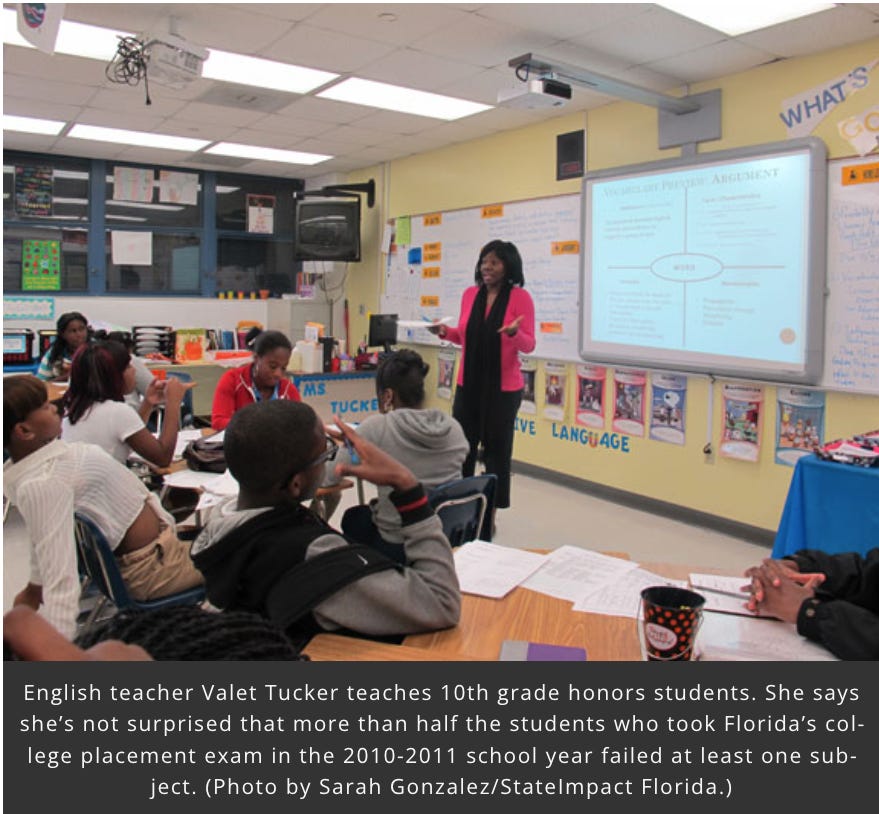
It was time to attend some classrooms and interview students. It was also time to plan what I’d produce. As we began to brainstorm in the newsroom, we envisioned a multipart series. To help us with reporting we hired Lynn Waddell, an independent journalist based in the Tampa area, and joined forces with Sarah Gonzalez, then a reporter for WLRN, a Miami-based NPR station.
What we saw in the classrooms was disturbing.
We found students learning the basics — the mechanics of writing sentences and paragraphs, how to read and understand context, how to do elementary math. These were skills they should have learned in elementary school and mastered before they graduated from high school.
Our reporting culminated in a four-part investigative series, 13th Grade: How Florida schools are failing to prepare graduates for college. The first story was published Dec. 3, 2012.
This work resulted from a collaboration between Florida Center for Investigative Reporting and WLRN.
The second story, 13th Grade: In state community college, a crisis of unprepared freshmen, focused on the cost students face when they find out they are not prepared for college.
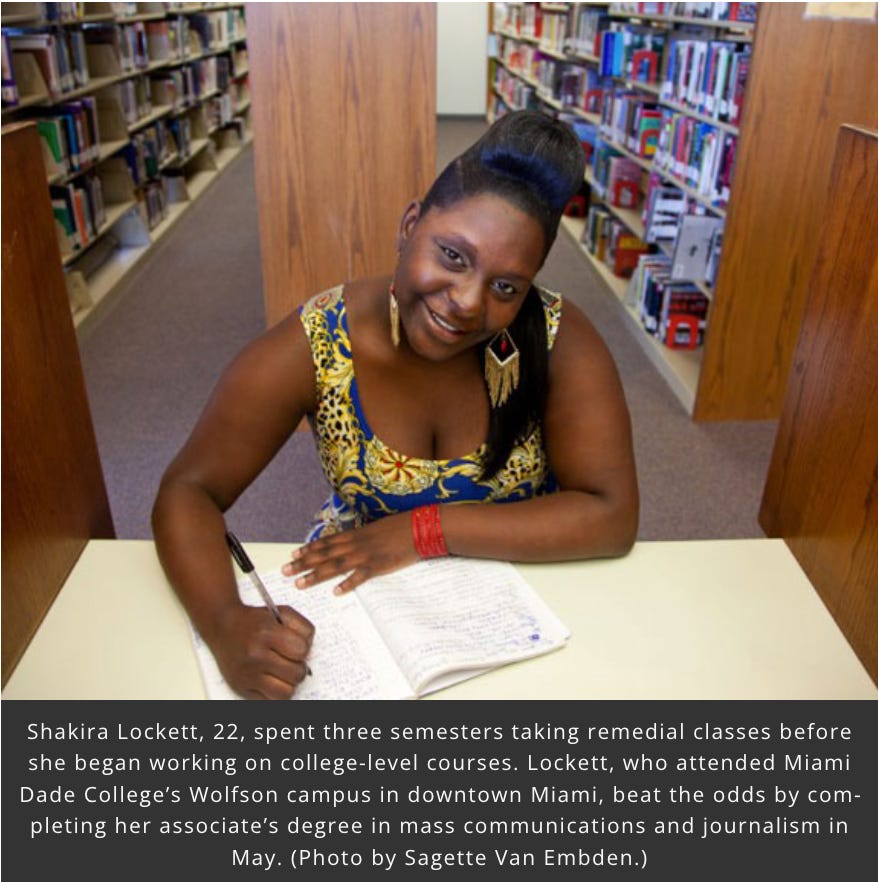
As we reported that story, we met Shakira Lockett, a Miami-Dade County native who described herself as a good student throughout her secondary school career. She passed her high school exit exam and graduated from Coral Gables Senior High School in 2008.
But when she took the placement test in Miami Dade College, she was shocked to find out that she flunked reading, writing and math, all three tested subjects.
Lockett spent more than a year taking remedial classes before she could start pursuing a degree in mass communication and journalism. The seven extra courses cost her $300 each.
She told us that she found remedial courses discouraging.
“It makes you feel dumb,” Lockett said. “And you ask yourself, ‘Is there something wrong with me?’”
There was a price to students showing up unprepared at Florida’s 28 community and state colleges. The cost of remedial education, shared by students and the state, had jumped from $118 million in 2004-05 to $168 million in 2010-11, a 42.4% jump.
I volunteered to write the story about mathematics because I knew from all my years covering education that this was a subject many students struggle with.
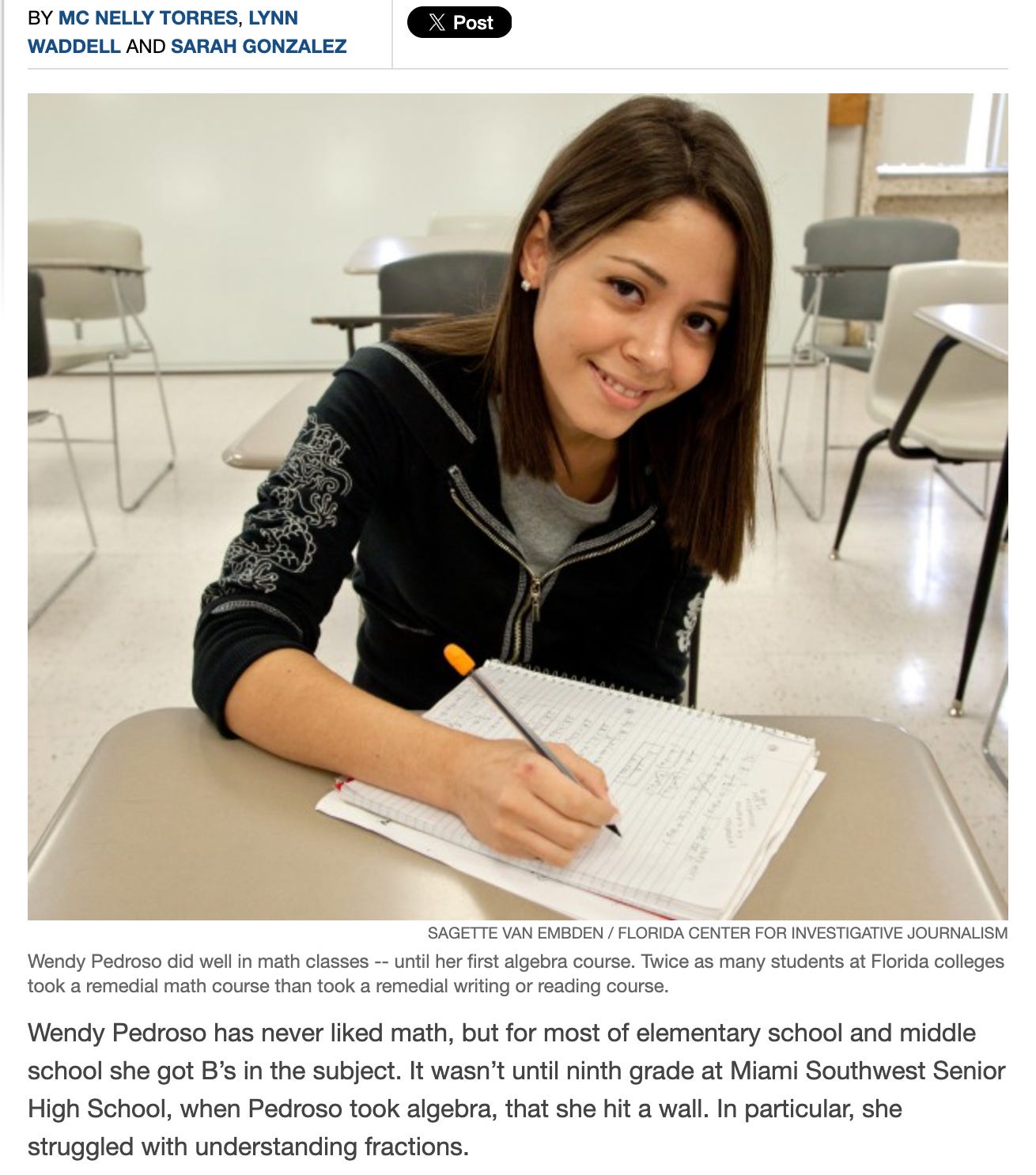
That’s when I met Wendy Pedroso, a student taking remedial math at the Miami Dade College’s campus in Kendall. Pedroso told me that she never liked math but she got B’s in the subject in elementary and middle school. It wasn’t until she was in high school, taking an algebra class, that she hit a wall.
“I kept getting stuck in the same place,” she told me, explaining that she struggled to understand fractions. She failed the class and worried about her chances in attending college. She sought help from tutors, retook algebra and passed math, graduating from high school in 2011.
But when Pedroso took the placement test to enroll in Miami Dade College, her struggles with math resurfaced. She failed the test’s math section.
She was embarrassed, she told me.
In the 2010-11 school year, 125,042 Florida college students needed to take remedial math, the investigation found. The numbers had also been growing for reading (54,489 students in remedial courses) and writing (50,906 students in remedial classes).
“I don’t know what happened with these people that come from high school,” said Isis Casanova de Franco, a remedial math professor at Miami Dade College, adding that though her granddaughter in the second grade could add, many of her college students couldn’t. “It’s very difficult to understand that they don’t even know how to add or subtract whole numbers.”
Florida’s situation was happening across the United States. A 2010 Columbia University study of 57 community colleges in seven states found that 1 in 2 incoming students needed to take remedial math courses.
A 2011 Harvard University study found that 32% of U.S. high school students graduating in 2011 were proficient in math. The U.S. ranked 32nd from the 65 nations Harvard researchers surveyed.
Vinton Gray Cerf, an internet entrepreneur quoted in the Harvard report, said the U.S. was not producing enough innovators because of a deteriorating K-12 education system. He also blamed the national culture that didn’t value engineering and science.
Jakeisha Thompson, a math instructor at Miami Dade College’s downtown Miami campus, told me she encountered students struggling with basic math skills every day in the classroom.
“Many of them have had a hatred for math for as long as they can remember,” Thompson said of the students. “And it goes all the way back to elementary school.”
This reporting became part of the third story, 13th Grade: More Florida students than ever before struggle with math, published Dec. 10, 2012.
The last story focused on how nontraditional students, many who had returned to school during the Great Recession, were straining the state college system.
My analysis found then that 85% of students taking remedial classes were age 20 or older.
College enrollment by older students has historically peaked during economic downturns, and the recession we were enduring then was no different. And the American Recovery and Reinvestment Act of 2009 created the biggest boost in federal student financial aid since the GI Bill.
Older students taking remedial courses told us the availability of financial aid was a factor in deciding to attend college.
José Ramos told us that financial aid allowed him to reduce his hours working as a phlebotomist — that’s the technician who takes blood samples for health tests — to pursue a nursing degree at St. Petersburg College.
“Being the only provider in a household and for what I make, you can’t survive and go to school,” Ramos told us. “Normally, right now, I wouldn’t be in school. I’d be working two jobs to support my family and not be able to see my son grow up like I did with my daughter.”
This final story was published Dec. 17, 2012, with a headline: 13th Grade: Older, returning students strain Florida’s college system.
Our series caused a stir at the Florida Legislature; soon they were looking at legislation. The series also earned awards, including the coveted Education Writers Association Awards and a regional Edward Murrow.
I was glad that my math skills made me look twice and scrutinize the numbers on that table. The numbers didn’t lie and the story was real.
This experience reinforced a strong belief and something I’ve told young journalists as I train them in data and investigative journalism. Math matters.
Journalists need at least rudimentary math skills, because we report on numbers all the time. And good journalists should scrutinize numbers to ensure they are accurate. Because if they are not accurate, you might have a good story.
It all adds up.
Thanks for reading.
Follow Mc Nelly on Bluesky, Threads, LinkedIn, X, Substack Notes and be part of the community I’m building online. Drop me a note if you want to provide feedback, would like me to discuss a specific subject, collaborate or just to say hello at mcnellytorres@substack.com. Join our chat room here.

Never miss an update—every new post is sent directly to your email inbox. For a spam-free, ad-free reading experience, plus audio and community features, get the Substack app.
Tell me what you think
Be part of a community of people who share your interests. Participate in the comments section, or support this work with a subscription.
You’re one of the best.